
PRACTICAL SUMMARY • REPRODUCTION AND NEONATAL CARE
Giardia in breeding kennels: interpreting tests, treating illness and reducing recurrence
Original publication: 14 February 2019 • Updated: 17 October 2026
For owners, breeders and veterinary teams: understanding signs, assessment and useful decisions.
When immediate action is needed
Seek prompt veterinary assessment for a puppy that is withdrawn, refuses food or water, vomits repeatedly, becomes dehydrated or has substantial pain. Collapse, marked weakness or breathing difficulty requires emergency care. Do not attribute severe diarrhoea automatically to a previous Giardia diagnosis or force-feed an animal that cannot swallow safely.
On small screens, swipe horizontally within a table to see all its columns.
1. Detection of infection is not the same as disease
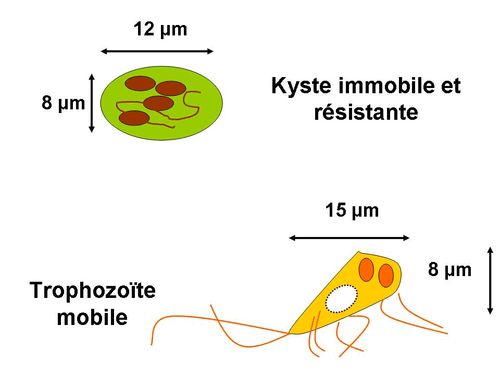
Giardia duodenalis, also called Giardia intestinalis, is a microscopic intestinal parasite. Its active forms can disturb digestive function, while cysts passed in faeces enable transmission. An infected dog may have diarrhoea or no apparent illness. The finding must therefore be interpreted alongside the animal’s condition and the kennel’s history.
Giardia should not become the universal explanation for loose stools. Dietary change, other parasites, a different infection or intestinal disease may coexist. Conversely, lack of weight loss does not exclude a contribution from Giardia. The practical question has two parts: does the parasite help explain the current problem, and which actions are useful for this animal and its contacts? The answer requires more than comparing one positive test with a familiar description of stool colour.
| Situation | What it indicates | What it does not prove |
|---|---|---|
| Diarrhoea with a positive test | Giardia may contribute to illness | That it is the only cause |
| Well dog with a positive test | Infection or detection without apparent disease | That treatment is always necessary |
| Persistent diarrhoea after care | A need for reassessment | Definite drug resistance |
| One negative test | The finding in the submitted sample | Freedom from infection throughout the kennel |
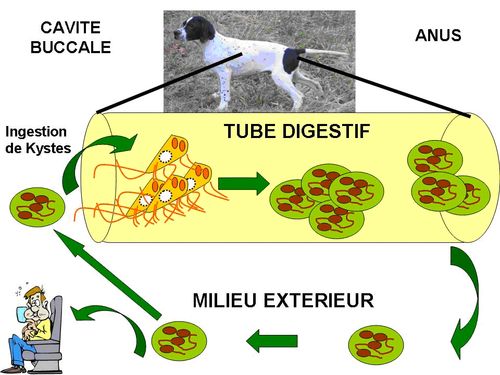
The existing illustrations below label the resistant cyst and motile trophozoite, followed by the faecal–oral cycle. Their original French labels are retained.
2. Understand how exposure continues in a group
Infection follows ingestion of cysts from faecal contamination. Water, bowls, floors, soiled coats, equipment and hands can contribute to circulation. Two dogs do not need to meet directly to share an exposure. Moist conditions and surfaces that are difficult to clean can sustain contamination even when the kennel looks generally tidy.
Young dogs are commonly affected, particularly around weaning and changes of environment. Stress, diet, concurrent infections and stocking density complicate interpretation. A prevalence measured in one selected population should not be assigned to every kennel. Rather than blaming a presumed source from one result, reconstruct introductions, movements, groups sharing equipment and the sequence of signs. This can reveal practical actions that a prescription alone would leave unresolved. Maintaining records also helps distinguish a new introduction from a problem that was already present.
3. Observe each puppy’s signs and growth
Diarrhoea may be intermittent, with soft or pasty stools and sometimes mucus. Poor growth, weight loss, altered appetite or coat changes can accompany prolonged digestive illness. No stool appearance, smell or colour diagnoses Giardia on its own. Examination and appropriate testing remain necessary, particularly when the puppy’s general condition is affected.
Within a litter, individual weight, appetite, vomiting and stool records are more useful than a group average. One puppy may need care while its littermates still play normally. Severity, hydration and overall condition determine urgency. A previous positive Giardia test must not delay investigation of parvovirus, obstruction or another problem in a deteriorating animal. Similarly, finding another pathogen does not automatically make Giardia irrelevant; more than one factor can contribute to a kennel episode.
| Observation | Why it helps | Reason for prompt contact |
|---|---|---|
| Weight and growth trajectory | Shows a lasting effect on development | Loss or stagnation with illness |
| Food and water intake | Indicates digestive tolerance | Persistent refusal or weakness |
| Stools and vomiting | Documents frequency and progression | Substantial losses, blood or repeated vomiting |
| Other affected animals | Identifies a possible group episode | Spread or deterioration within the litter |
4. Prepare a useful consultation and samples
The veterinarian assesses hydration, body condition, abdominal findings and signs of more general disease. Age, weaning date, feeding, animal movements and previous treatments matter. Bring the original laboratory reports rather than summarising everything as a positive stool analysis. A rapid antigen test, microscopy and PCR do not provide identical information.
Samples need clear identification and storage according to laboratory instructions. A pooled sample may inform group assessment without assigning the result to each puppy. Shedding can fluctuate, so repeated samples or a complementary method may be useful. Selection should follow the question rather than an automatic sequence of every available test. Report recent medicines and dates, including administration problems. This helps establish what was actually investigated and whether the new result can reasonably be compared with an earlier one.
| Information | Clinical purpose | Precaution |
|---|---|---|
| Chronology of signs | Connects cases and exposures | Give actual dates |
| Previous laboratory reports | Allows comparison of methods and findings | Keep the complete report |
| Treatments received | Checks administration and interpretation | Name products, dates and incidents |
| Groups and movements | Identifies shared risks | Do not assign a pooled result to every individual |
5. Interpret microscopy, antigen tests and PCR
Microscopy identifies parasitic forms when they are present in the sample. Antigen tests detect a parasite component, while PCR detects genetic material. Their performance depends on the method, sample and clinical context. A more sensitive analytical method does not automatically answer whether Giardia is the cause of this dog’s illness.
A positive result alone cannot explain every digestive sign. After treatment, the timing and method can complicate distinction between continuing infection, residual detection and new exposure. Conversely, a negative result should not end the investigation if diarrhoea or poor growth continues. Ask what the recheck is intended to decide: further investigation, review of treatment or changes to contact management. Comparing different tests without their dates and purpose may create a false impression of repeated treatment failure.
| Method | Contribution | Limit |
|---|---|---|
| Faecal microscopy | Demonstrates parasitic forms | Fluctuating shedding and preparation quality |
| Antigen test | Detects a Giardia component | Does not measure causality or severity by itself |
| PCR | Sensitive detection of genetic material | Positivity differs from proof of active clinical disease |
| Selected genotyping | Addresses a specific assemblage-related question | Not necessary for every uncomplicated diarrhoea episode |
6. Safe first actions while results are pending
Provide access to clean water, remove faeces promptly and reduce sharing of contaminated equipment. Separate a diarrhoeic animal from vulnerable groups in conditions compatible with welfare. Contact the clinic before moving several sick puppies so reception and useful sampling can be organised. These actions can begin without a definitive label for the infection.
Do not impose prolonged fasting on a young puppy, repeatedly change diets or reuse an old antibiotic prescription without advice. Digestive losses may require professional fluid support. In a puppy that is very weak, repeatedly vomiting or unable to swallow safely, forcing large quantities of food or water can be dangerous. Hygiene supports treatment but does not replace examining an animal that is deteriorating. The immediate objective is a stable, comfortable patient, not a particular laboratory result.
12. Protect people without overstating the risk
Giardia genetic assemblages differ in host association. Transmission between dogs and people is possible, but a canine positive result does not establish the animal as the source of a human infection. A routine test does not necessarily identify the assemblage involved. Tell the veterinarian about young children or an immunocompromised person so precautions can be adapted.
Wash hands after handling faeces or contaminated equipment, prevent food contamination and limit contact with soiled areas. A symptomatic person should consult a physician and must not take the dog’s veterinary treatment. When both people and animals are affected, their healthcare professionals can coordinate relevant investigations without immediately assigning the source to one or the other. Practical hygiene is useful even when the exact transmission route cannot be established.
Read the complete article with a free reader account
The complete article develops the remaining clinical questions, practical decisions and follow-up. Registration is free; a reader account does not confer verified veterinary status.
Already registered? Sign in to continue reading.
Frequently asked questions
Does a positive test explain all diarrhoea?
No. Giardia may contribute to signs or be detected alongside another cause. Examination and alternative diagnoses remain important.
Can a healthy-looking dog test positive?
Yes. Infection can be subclinical. The treatment decision depends on context, including group housing and human exposure.
Does one negative test exclude infection?
Not always. Shedding fluctuates and methods differ. Further samples may be useful for a defined clinical question.
Must every dog in the kennel be treated?
No. A group strategy may be appropriate in a higher-risk setting, but it requires assessment rather than an automatic response to any positive result.
Does recurrence mean drug resistance?
No. Administration, environment, another disease and new exposure need assessment. A result alone cannot demonstrate resistance.
Can I use the floor disinfectant on the puppy?
No. Surface products are not skin treatments. Coat care must be safe and avoid chilling the animal.
Can my dog infect a person?
Transmission is possible with some assemblages, but cannot be inferred from any canine positive test. Symptomatic people should consult their physician.
Which signs should not wait?
Lethargy, poor intake, repeated vomiting, dehydration, pain or substantial growth failure require prompt advice. Collapse and breathing difficulty are emergencies.
Reproduction • Targeted assessment
A focused specialist opinion
At CRECS near Toulouse and Bordeaux Sud, Dr Xavier Lévy helps select and interpret useful investigations for digestive and growth problems in breeding groups. French- or English-language coordination with the treating veterinarian can support an individual kennel plan, according to the clinical situation and applicable professional framework.
Selected references
[1] Lévy X. Giardiose, 2015; Les diarrhées en collectivité, 2022, selected diagnostic and Giardia sections. Personal clinical and teaching sources, critically updated.
[3] Walz KC et al. Long-Term Follow-Up After Acute Gastroenteritis Caused by Giardia Infection in Juvenile Dogs. J Vet Intern Med. 2025;39:e70123. Retrospective study, 49 affected dogs and 50 controls; abstract and selected introduction consulted. DOI: 10.1111/jvim.70123.
© Xavier Lévy 2026. Third-party rights reserved.