
Feline reproduction · Practical summary
Type breeding cats, identify a high-risk mating and prepare the litter’s first hours.
Dr Xavier Lévy · Originally published: 2019-02-19 · Updated: 7 October 2026
Key points. A type B queen may transfer anti-A antibodies in her colostrum that destroy red blood cells in type A or AB kittens. Kittens are often normal at birth and may fade within hours. The safest prevention is to know both parents’ blood types before mating. If a high-risk mating is maintained or discovered late, the veterinarian should prepare neonatal typing, compatible early feeding and emergency care before delivery.
For cat owners and breeders. Neonatal sampling, blood products and all transfusion procedures are restricted to veterinary teams.
After nursing: weakness, pallor or dark urine
- A kitten that nursed and then becomes weak, cold, inactive or stops feeding.
- Pale or yellow mucous membranes, rapid breathing, red-brown urine or collapse.
- Sudden death of one or more kittens that appeared normal at birth.
- Delayed necrosis of the tail tip in a surviving kitten.
Immediately prevent the suspect kitten from further nursing and contact a veterinarian urgently. Do not wait for a weight change or attempt transfusion, sampling or force-feeding at home.
1. Feline blood types: A, B and AB
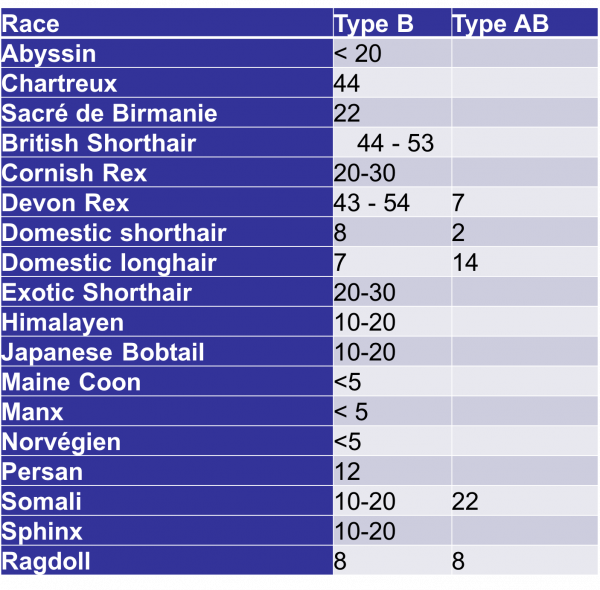
The best-defined feline red-cell system is the AB system, which is not the same as the human ABO system. Its phenotypes are A, B and AB—the latter is also called C in some genetic publications. Type A is most common overall, type B varies markedly by breed and region, and type AB is rare. [4]
Red-cell antigens are located on the erythrocyte membrane. Cats naturally possess antibodies against certain antigens that they lack. Type B cats generally have particularly active anti-A antibodies; type A cats may possess anti-B antibodies, which are usually less potent. Type AB cats normally have neither anti-A nor anti-B. Consequently, a mismatch can be serious at the first transfusion, and maternal colostrum can cause haemolysis in a newborn.
Breed is not a blood test. It identifies populations in which type B may be more frequent, but cannot determine an individual cat’s type. Published frequencies vary by country, lineage, sampling and period.
A regional estimate, not a national reference range
In a retrospective Lyon study published in 2019, 357 cats selected from blood donors and intensive-care patients were 84.3% type A, 14.0% type B and 1.7% type AB. Among 320 non-pedigree cats, the theoretical risk of a random mating exposing kittens to neonatal isoerythrolysis was estimated at 12.3%. This was not a random national sample: the findings support typing in France but cannot predict one cat’s blood type. [3]
2. How can colostrum destroy red blood cells?
Placental antibody transfer in cats is limited. After birth, kittens absorb maternal antibodies from colostrum during a short window whose efficiency declines rapidly. This is normally protective. It becomes dangerous when a type A or AB kitten drinks colostrum from a type B queen: maternal anti-A antibodies enter the kitten’s circulation and bind to its red blood cells. [1] [10]
Haemolysis can be intravascular or extravascular. Severity is influenced by the amount and activity of maternal antibodies, colostrum intake, intestinal absorption and the kitten’s type. Littermates can therefore have very different outcomes.
This mechanism explains why kittens are often vigorous at birth and deteriorate only after nursing. It also explains why waiting for signs makes prevention less effective.

3. Which AB-system matings are at risk?
| Queen | Tom | Classical risk to kittens | Practical approach |
|---|---|---|---|
| B | A or AB | Yes, when type A or AB kittens are born. A type A phenotype alone does not disclose all paternal alleles. | Avoid the mating when possible; otherwise prepare a complete veterinary plan before delivery. |
| B | B | No classical anti-A isoerythrolysis: kittens are type B under the usual model. | Retain results and investigate any discordance. |
| A | B | The classic severe disease caused by a type B queen’s anti-A is not expected. | Typing remains relevant to selection and any transfusion. |
| A | A or AB | No classical risk attributable to a type B queen. | Absence of this risk does not exclude other neonatal diseases. |
| AB | A, B or AB | Maternal anti-A or anti-B is not expected within the AB system. | Confirm any weak or atypical result. |
Mating outcomes depend on genotype, not phenotype alone. A type A cat may carry an allele associated with type B. Type AB/C inheritance is more complex than the old shorthand “A dominant over B”. Breeding advice should integrate laboratory results, breed and, where relevant, CMAH genotyping. [5]
4. Blood typing, genotyping and cross-matching answer different questions
| Test | Question answered | Breeding value | Limitations |
|---|---|---|---|
| Serological A/B/AB typing | Which antigens are expressed on red blood cells? | Baseline test for both parents before mating. | Weak reactions, severe anaemia, autoagglutination, recent transfusion or atypical AB results may complicate interpretation. |
| CMAH genotyping | Which tested variants are associated with the AB system and inheritance risk? | Complements phenotype to plan matings and identify some carriers. | May not detect every variant in every breed; rare genotype–phenotype discordances occur. |
| Pre-nursing neonatal typing | Which kittens in a high-risk litter are A/AB or B? | Supports individual management when sampling and assay are validated. | Tiny samples, contamination and weak reactions require experience and sometimes confirmation. |
| Major and minor cross-match | Are plasma and red cells from two specific individuals compatible in vitro? | May help in complex cases; chiefly important for transfusion safety. | Does not provide genotype, predict every kitten or replace blood typing. |
Unexpected results should be confirmed by an experienced laboratory, ideally using a complementary method. A 2021 report described two cats identified as B by a card method but AB by tube testing, with unusual CMAH variants. Such cases are rare but important when a litter or transfusion depends on the result. [6]
Genotyping is particularly useful for inheritance; phenotyping identifies the blood type actually expressed. They are complementary. When a result is AB, weak or discordant, it should be resolved rather than selecting whichever answer permits the planned mating.
5. Prepare a high-risk litter before delivery
The safest measure is to avoid mating a type B queen to a type A or AB tom. However, a mating may already have occurred, genetic diversity may be a consideration, or the risk may be discovered during pregnancy. A written veterinary plan is then essential.
- Confirm parental results and resolve weak or discordant reactions.
- Organise birth monitoring, identifying each kitten and recording its birth time.
- Prepare pre-nursing neonatal typing where technically available: equipment, trained personnel, method and an action for each result.
- Arrange compatible initial feeding for temporarily separated A or AB kittens: a suitable foster queen or traced stored colostrum, followed by species-appropriate milk replacer. Formula provides nutrition but does not itself provide colostral immune protection.
- Maintain warmth and maternal care while minimising chilling, identity errors and aspiration.
- Plan return to the queen after the intestinal absorption window according to the veterinarian’s protocol, rather than an improvised clock time.
- Define emergency access: contacts, transport and availability of haematology, blood typing, cross-matching and neonatal transfusion.
Why not separate the entire litter without a plan? Type B kittens can nurse from a type B queen without AB-system isoerythrolysis. Unprepared separation deprives kittens of maternal care and may cause hypothermia, inadequate nutrition or failed passive transfer. Management should be individualised.
6. Recognise and confirm neonatal isoerythrolysis
Presentation ranges from peracute death to mild, initially inconspicuous anaemia. Not every sign occurs, and none is entirely specific. Infection, haemorrhage, congenital disease, hypoglycaemia or inadequate milk intake may also cause a kitten to fade.
| Finding | Possible interpretation | Targeted veterinary assessment |
|---|---|---|
| Weakness after nursing, stopped suckling, hypothermia | Anaemia/hypoxia, but also metabolic disease, infection or ineffective feeding. | Immediate examination, temperature, glucose when indicated, packed cell volume/CBC when feasible. |
| Red-brown urine, jaundice | Marked haemoglobinuria and haemolysis until proven otherwise. | Urine, bilirubin, kidney function and serial anaemia assessment according to clinical status. |
| Pallor, tachypnoea, tachycardia, collapse | Inadequate oxygen delivery and a potential transfusion emergency. | Packed cell volume/haemoglobin interpreted with oxygenation and perfusion signs. |
| Different outcomes among littermates | Different blood types and colostrum exposure; other causes remain possible. | Type the queen and kittens; examine the litter and mother. |
| Delayed tail-tip necrosis | A recognised complication in some survivors. | Assess tissue viability, secondary infection and haematological status. |
Diagnosis combines a type B queen, a type A or AB kitten, timing after nursing and evidence of haemolysis. A direct antiglobulin test may support the immune mechanism, although availability and neonatal interpretation require care. When a kitten dies, prompt post-mortem examination and sampling can distinguish isoerythrolysis from other causes of litter mortality.
7. Clinical management: stop further exposure and support the kitten
Once disease is suspected, a type A or AB kitten should no longer ingest the type B queen’s colostrum. This does not neutralise antibodies already absorbed, so urgent assessment remains necessary. Controlled warming and correction of hypoglycaemia, dehydration, impaired oxygenation and acid–base disturbances are tailored to examination findings.
Progressive anaemia or hypoxia may require transfusion. Red-cell selection is unusually complex because it depends on the kitten’s age, circulating maternal antibodies, donor type and cross-match. Donor selection, product preparation, route, volume, rate and monitoring belong to an experienced veterinary team. Detailed protocols and doses should not be followed from a public page.
Monitoring includes anaemia, urine and mucous membrane colour, kidney function, temperature, feeding and weight. Initial stabilisation does not exclude later deterioration. Prognosis depends on the rate of haemolysis and speed of care; prevention is substantially more effective than treating a symptomatic kitten.
8. Practical prevention in a breeding programme
- Serologically type breeding cats before their first mating and retain the laboratory report.
- Add appropriate genotyping when it can clarify carrier status, without automatically replacing phenotype.
- Record method, date, laboratory and previous transfusions; a message stating only “A” is insufficient traceability.
- Repeat an old, weak or AB result, one inconsistent with parentage, or one obtained under conditions that may disturb the assay.
- Avoid high-risk matings where compatible with the breeding programme.
- If a mating is maintained, prepare equipment, compatible feeding, monitoring and access to care before birth.
- After a suspected case, document every kitten rather than assuming survivors were type B.
Selection should not eliminate all type B cats abruptly at the expense of genetic diversity. The goal is to avoid unplanned incompatible matings and preventable losses by combining reproductive advice, population genetics and neonatal safety.
9. Recent developments: beyond the AB system
The AB system explains classical feline neonatal isoerythrolysis. Other red-cell antigens exist. Following the discovery of Mik, five feline erythrocyte antigens, FEA 1–5, were mapped in 2021 using incompatibilities and naturally occurring alloantibodies. FEA 6 was described in 2024, and an April 2025 study estimated its prevalence in a population of type A cats. [7] [8] [9]
These findings chiefly improve understanding of transfusion reactions despite matched AB types. They do not show that every FEA causes natural neonatal isoerythrolysis or that all breeding cats should undergo FEA 1–6 screening. The AB system remains the reproductive priority; in transfusion medicine, typing and cross-matching address complementary risks.
What has changed. Saying that cats have “only three blood groups” is now too simplistic. There are three common phenotypes within the AB system, while additional red-cell antigens have been identified and their clinical roles continue to be defined.
10. What about dogs?
Dogs have several red-cell antigens, including DEA, Dal and Kai systems. Unlike type B cats, dogs generally lack strongly reactive naturally occurring anti-DEA 1 antibodies before sensitisation. Spontaneous canine neonatal isoerythrolysis is therefore much rarer. It may be considered when a bitch has been sensitised, especially by an incompatible transfusion, and puppies develop haemolysis after colostrum intake.
This difference does not make canine transfusion risk-free: typing and cross-matching are selected according to history and clinical context. A canine litter with anaemia or clustered deaths needs a full differential diagnosis rather than automatic use of the feline protocol.
11. Practical questions
Should every breeding cat be blood typed?
This is the safest approach before breeding, especially in breeds or lines in which type B occurs. Breed alone cannot provide the answer, and a documented result may also be valuable during an emergency transfusion.
Can a type A cat carry a type B allele?
A type A phenotype may be associated with an allele linked to type B. Genotyping can support inheritance advice, but it should be interpreted alongside phenotype and the assay’s breed-specific limitations.
Is a DNA test sufficient before mating?
Not always. It detects known CMAH variants, while blood typing shows the antigens actually expressed. A discordance, AB result or poorly validated breed warrants specialist confirmation.
Can a type B queen nurse her own type B kittens?
Yes with respect to classical anti-A disease. In a litter sired by a type A or AB tom, each kitten must be reliably identified before deciding which can nurse.
Does formula prevent failure of passive immunity?
It provides suitable nutrition but not necessarily colostral antibodies. A compatible source of passive protection should be considered with the veterinarian where feasible.
Can kittens return to the queen after a fixed number of hours?
Intestinal antibody absorption declines during the first day, but the plan should not rely on an approximate clock time. The veterinarian sets separation and return according to available evidence and each kitten’s safety.
Is a kitten that looks normal after 24 hours safe?
Not necessarily. Anaemia, jaundice or renal complications may evolve later. Every high-risk mating warrants individual monitoring and a low threshold for reassessment.
Plan the litter
When does specialist advice help?
An AB or discordant result, a type B queen, a mating already completed or neonatal losses: a targeted plan organises testing and first feeds before an emergency. Dr Xavier Lévy offers consultations at CRECS near Toulouse and Bordeaux Sud, with French- or English-language advice coordinated with your treating veterinarian.
12. References and scope
This summary combines Dr Xavier Lévy’s personal document Canine and feline blood groups with his recent 2026 neonatal materials. The Drive search identified no personal file specifically dedicated to blood groups and modified within the last 12 months; older information was therefore checked against current publications. Personal source documents are not offered for download.
- Silvestre-Ferreira and Pastor. Feline Neonatal Isoerythrolysis and the Importance of Feline Blood Types. Veterinary Medicine International, 2010. Full review consulted. Full text.
- Bücheler. Fading kitten syndrome and neonatal isoerythrolysis. Veterinary Clinics of North America: Small Animal Practice, 1999. Foundational reference cited by reviews.
- Nectoux et al. Assessment of risks of feline mismatched transfusion and neonatal isoerythrolysis in the Lyon (France) area. JFMS Open Reports, 2019. Full text.
- Taylor et al. 2021 ISFM Consensus Guidelines on the Collection and Administration of Blood and Blood Products in Cats. Journal of Feline Medicine and Surgery, 2021. Expert guidance used here for terminology and transfusion limitations. Full text.
- Kehl et al. Molecular characterization of blood type A, B, and C (AB) in domestic cats and a CMAH genotyping scheme. PLOS ONE, 2018. Full text.
- Hara et al. Phenotypic and Genetic Characterization for Incompatible Cross-Match Cases in the Feline AB Blood Group System. Frontiers in Veterinary Science, 2021. Two discordant cases. Full text.
- Binvel et al. Identification of 5 novel feline erythrocyte antigens based on the presence of naturally occurring alloantibodies. Journal of Veterinary Internal Medicine, 2021. DOI.
- Ternisien et al. Identification of feline erythrocyte antigen 6 and lack of alloimmunization to feline erythrocyte antigen 4 in cats. Journal of Veterinary Internal Medicine, 2024. DOI.
- Bajon et al. Prevalence of a Novel Immunogenic Feline Erythrocyte Antigen (FEA 6) and Expression Patterns Between FEAs. Journal of Veterinary Internal Medicine, 11 April 2025. Full text. The journal also flags a 2025 erratum.
- Casal, Jezyk and Giger. Transfer of colostral antibodies from queens to their kittens. American Journal of Veterinary Research, 1996. PubMed.
Veterinary thesis consulted at metadata and indexed-extract level: M Thévenet, La pathologie néonatale du chaton : mémento à l’usage du vétérinaire, ENVA, 2007. The institutional portal required authentication when opening the PDF, so the complete thesis is not presented as reread. Historical breed-frequency figures were not reused as current references.
Dr Xavier Lévy shares his knowledge freely to support better care. This summary cannot replace a plan tailored to parental blood types, the litter and locally available diagnostic resources.
Dr Xavier Lévy · Originally published: 2019-02-19 · Updated: 7 October 2026
© Xavier Lévy 2026 — original writing of this summary. Publications, illustrations and other third-party contributions retain their own rights; applicable contracts remain reserved.